Missing several teeth creates a different restorative challenge than replacing one tooth. If you have three or four missing teeth, you may assume every space needs a separate implant. That is not always true. The number of implants depends on tooth location, jawbone volume, bite forces, remaining teeth, and the restoration selected for your individual clinical circumstances and goals.
For patients considering multiple dental implants Weston FL, treatment planning should focus on creating a stable, functional restoration—not simply replacing every missing tooth individually. Strategic planning for multiple dental implants Weston FL may allow several replacement teeth to be supported with fewer implants when clinically appropriate.
Why Replacing Multiple Missing Teeth Requires Planning
When teeth are adjacent, an implant-supported bridge may replace the section without an implant beneath every replacement tooth.
If gaps are in different areas, treatment with multiple dental implants Weston FL may be suitable. This is why planning for multiple dental implants Weston FL begins with an examination and imaging.
The objective is to identify suitable implant positions and distribute chewing forces effectively.
Do You Need One Implant for Every Missing Tooth?
No. One implant per missing tooth is only one possible approach.
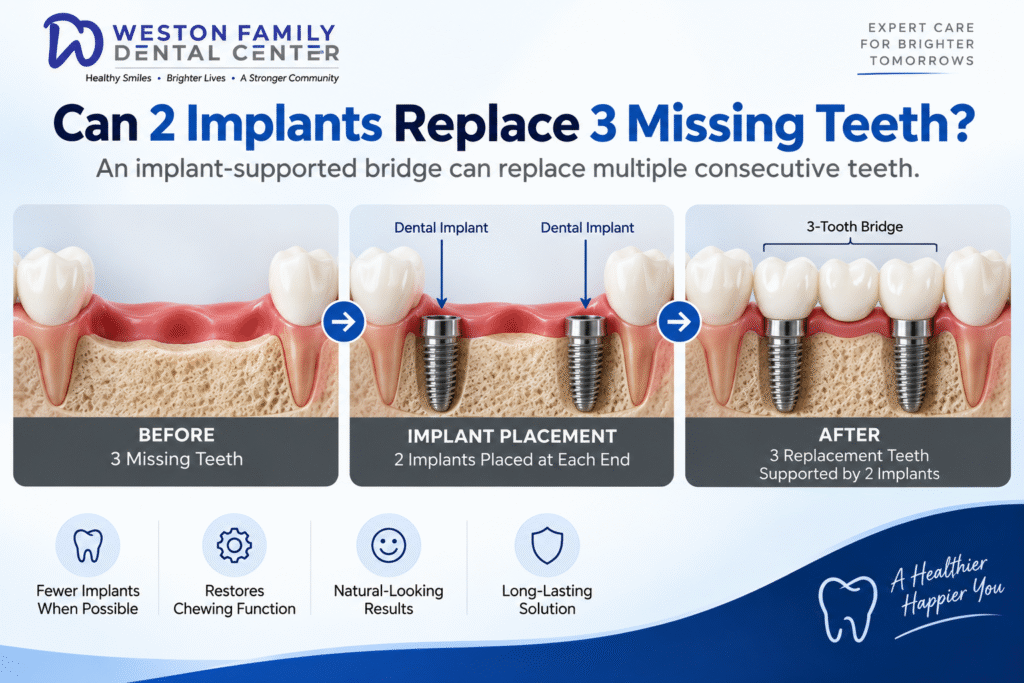
For example, a patient missing three consecutive teeth may be a candidate for a three-unit bridge supported by two implants. When considering multiple dental implants Weston FL, the implants act as stable anchors while the replacement tooth between them forms part of the bridge.
With dental implants for multiple missing teeth, the appropriate number is determined by clinical findings and restorative design—not simply by counting empty spaces. Your dentist may recommend multiple dental implants Weston FL in positions that provide the support the final restoration needs.
3 Ways to Replace Multiple Missing Teeth
1. Individual Implant Crowns
Each missing tooth can be replaced with its own implant and crown.
2. Implant-Supported Bridge
An implant-supported bridge can replace several adjacent teeth using strategically positioned implants. Instead of placing an implant beneath every replacement tooth, selected implants support the bridge.
For patients comparing tooth replacement options Weston, this approach can reduce surgical sites while providing fixed support. An implant supported bridge Weston plan may be useful when neighboring teeth are missing.
3. Full-Arch Restoration
When most or all teeth in an upper or lower arch are missing, a full-arch restoration may be more appropriate than treating every tooth separately. Weston Family Dental Center describes full-mouth treatment using four to six strategically placed implants to support a complete arch.
Planning multiple dental implants Weston FL for a full arch requires consideration of the entire jaw, available bone, bite, and final restoration.
5 Factors That Determine How Many Implants You Need
1. Location of Missing Teeth
Front and back teeth experience different functional demands, so three missing front teeth may require a different support strategy than three missing molars.
2. Jawbone Volume
Dental implants need adequate bone for stable support. When teeth have been missing for an extended period, the surrounding bone can shrink. If bone volume is insufficient, bone grafting may be discussed.
3. Remaining Teeth and Gum Health
Healthy remaining teeth and gums contribute to a stable restorative environment. Gum disease, damaged neighboring teeth, or tooth mobility may need attention before treatment.
4. Bite and Chewing Forces
Your bite affects how forces transfer through a restoration. Bruxism, heavy chewing forces, and uneven contact may influence how multiple dental implants Weston FL are positioned and supported.
5. Final Restoration
Individual crowns, bridges, and full-arch restorations have different structural requirements. The positions of multiple dental implants Weston FL must be planned around the final restoration.
For multiple dental implants Weston FL, these factors are evaluated together to develop a plan specific to your mouth.
What Happens During Implant Planning?
Your consultation starts with an evaluation of your oral health, missing teeth, and goals. Diagnostic imaging may be used to assess bone volume and important anatomical structures.
Your dentist considers tooth location, bone availability, gum health, bite mechanics, remaining teeth, and the planned restoration. This helps determine implant positions and the number required.
Some patients may need extraction or bone grafting before implant placement. Others may have sufficient bone and healthy tissues to proceed without additional preparation.
The purpose of multiple dental implants Weston FL is not to place as many implants as possible. It is to create a foundation for a durable restoration.
Choosing the Right Multiple Missing Teeth Replacement
If you are researching multiple missing teeth replacement, do not select treatment by counting lost teeth.
An evaluation can determine whether individual implants, an implant-supported bridge, or a full-arch restoration is appropriate. Your dentist can explain treatment stages, bone requirements, maintenance, and alternatives.
For multiple dental implants Weston FL, individualized planning matters because implant placement affects both the surgical process and the final function of the restoration.
Restore Your Smile With a Personalized Plan
Replacing several missing teeth does not automatically mean placing one implant for every gap. Strategic implant placement can support bridges, individual crowns, or full-arch restorations when clinically appropriate.
If you are considering multiple dental implants Weston FL, Weston Family Dental Center can evaluate your jawbone, remaining teeth, gums, and bite and discuss an appropriate tooth replacement approach. The practice offers dental implant treatment in Weston, including full-mouth solutions for more extensive tooth loss.
A consultation can help you understand whether multiple dental implants Weston FL are suitable for your situation, how many implants may be needed, and which restoration may best support your long-term oral function.
Can two implants replace three missing teeth?
Yes. In appropriate cases, two dental implants can support a three-unit implant-supported bridge, allowing three consecutive missing teeth to be replaced without placing an implant beneath every replacement tooth.
Can dental implants replace several teeth at once?
Yes. Several missing teeth can be replaced using individual implant crowns, implant-supported bridges, or full-arch implant restorations. The appropriate approach depends on the location of the missing teeth, bone availability, bite, and overall oral health.
Are implant-supported bridges removable?
An implant-supported bridge is generally a fixed restoration. It is secured to dental implants and is typically removed only by a dental professional for maintenance or evaluation.
Are multiple dental implants difficult to clean?
Cleaning requirements depend on the type of restoration. Individual implant crowns can generally be cleaned similarly to natural teeth. Implant-supported bridges may require additional tools, such as floss threaders, interdental brushes, or a water flosser.
Can dental implants replace missing back teeth?
Yes. Dental implants can replace missing premolars and molars. Because back teeth experience significant chewing forces, implant position and restoration design need to provide appropriate support.
How long does treatment with multiple implants take?
The timeline varies depending on your oral health, whether extraction or bone grafting is needed, implant healing, and the final restoration. Your dentist can provide a more specific timeline after examining your teeth and jawbone.