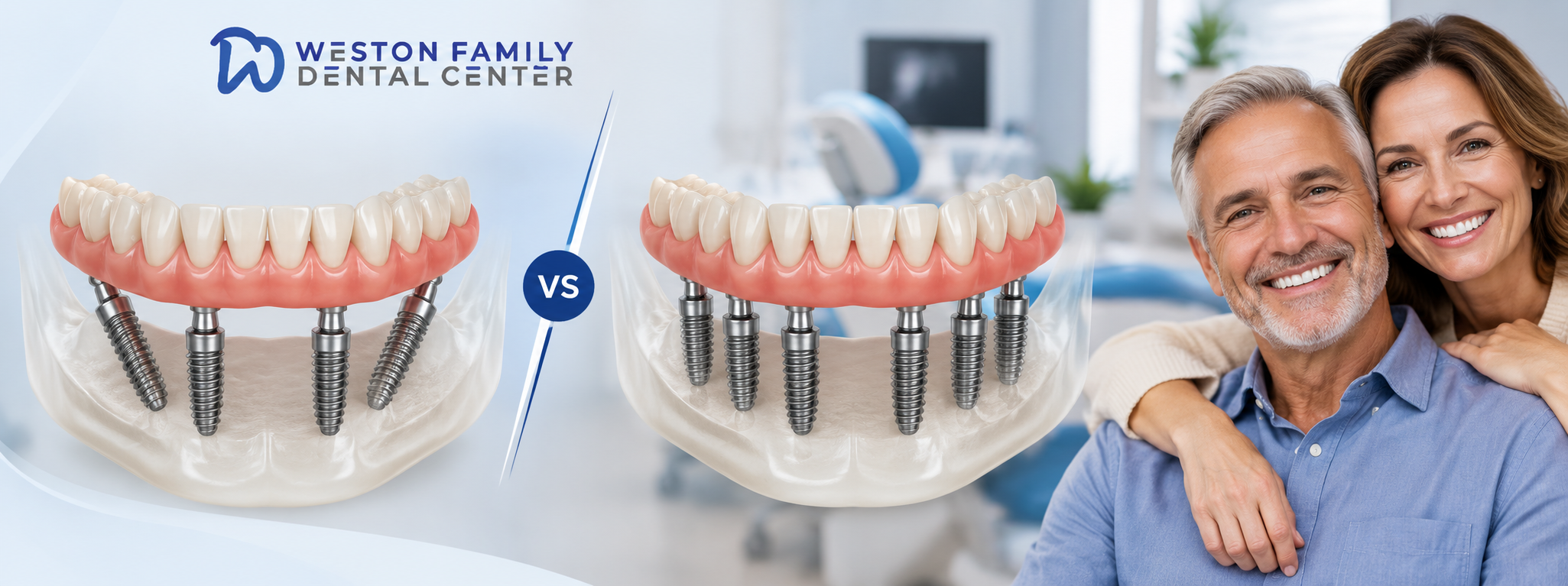
Patients researching full-mouth tooth replacement often encounter terms such as All-on-4, full-arch dental implants, and full-mouth dental implants. Because these terms are sometimes used interchangeably, it can be difficult to understand All-on-4 vs full-arch dental implants and what treatment is actually being discussed.
If you’re researching All-on-4 dental implants Weston FL, the most important distinction is that All-on-4 describes a specific full-arch implant treatment concept, while “full-arch dental implants” is a broader description of replacing an entire upper or lower arch with implant support.
The two terms can overlap, but they do not necessarily describe identical treatment plans. The number and positioning of implants, type of restoration, jaw anatomy, available bone, bite, and long-term treatment goals can all influence the approach.
What Does “Full-Arch Dental Implants” Mean?
Full-arch dental implants is a broad term for replacing an entire dental arch with an implant-supported restoration.
An arch can refer to the complete set of teeth in either the:
- Upper arch
- Lower arch
Instead of replacing each missing tooth separately, an implant-supported full-arch restoration is designed to replace the teeth of an entire arch as one coordinated restorative solution.
Depending on the treatment plan, implants are strategically positioned in the jaw to support a prosthetic arch. The final restoration may be designed as a fixed set of replacement teeth, meaning the patient does not remove it as they would a traditional removable denture.
The important point is that “full-arch” describes the scope of the tooth replacement, rather than one single implant configuration.
There is no universal implant number or positioning pattern that applies to every full-arch case. Treatment planning must account for the patient’s anatomy and restorative requirements.
What Are All-on-4 Dental Implants?
All-on-4 is a specific implant-supported full-arch treatment concept.
The name refers to a treatment approach that uses strategically positioned implants to support a full arch of replacement teeth. In appropriate cases, implant positioning can make use of areas of available bone, including the use of angled implants as part of the planned configuration.
The objective is to create stable implant support for a prosthetic arch rather than placing one implant for every missing tooth.
However, the term “All-on-4” should not be interpreted as a guarantee that every patient will receive exactly the same implant configuration. Clinical terminology can vary, and the final treatment plan depends on factors such as bone anatomy, jaw structure, oral health, bite, and restoration design.
This is why patients considering All-on-4 implants in Weston should ask their dentist what the term specifically means in their proposed treatment plan.
All-on-4 vs Full-Arch Dental Implants in Weston, FL: How Is the Approach Different?
The easiest way to understand All-on-4 vs full arch implants is to think of All-on-4 as a particular treatment concept within the broader category of implant-supported full-arch treatment.
| Factor | All-on-4 | Full-Arch Dental Implants |
| Meaning | A specific full-arch implant treatment concept | Broad term for replacing an entire dental arch with implant support |
| Number of implants | Traditionally associated with four strategically positioned implants, when appropriate | Implant number can vary according to the treatment plan |
| Implant positioning | Strategic positioning is central to the concept and may include angled implants | Positioning depends on anatomy, restoration design, and clinical objectives |
| Restoration | Designed to support a full-arch prosthetic restoration | Can involve different full-arch restoration designs |
| Treatment planning | Follows the requirements of the specific treatment concept while remaining patient-specific | Broader planning framework tailored to the individual |
| Bone considerations | Implant positioning may be planned around available bone | Bone anatomy is evaluated when determining implant placement and restoration |
| Patient-specific factors | Anatomy and functional requirements still determine whether the concept is appropriate | Anatomy, oral health, bite, restoration preferences, and clinical goals influence the approach |
The key takeaway is that All-on-4 is not simply another name for every full-arch implant treatment.
Rather, it is one approach that may be considered when planning implant-supported full-arch tooth replacement.
5 Factors That Influence Which Full-Arch Approach May Be Recommended
The terminology matters, but the treatment decision matters more. Your dentist needs to evaluate your individual circumstances before recommending a particular full-arch approach.
1. Available Bone
Implants require suitable bone support, so the anatomy and volume of available bone are important considerations when planning implant positioning.
This does not mean that a particular amount of bone automatically determines one treatment option. Instead, your dentist evaluates the available anatomy and considers how implants and the planned restoration can work together.
If you want to understand this issue in more detail, see our guide to bone grafting before dental implants.
2. Upper vs Lower Jaw
The upper and lower jaws have different anatomical characteristics, and these differences can affect treatment planning.
The location of important anatomical structures, the shape of the arch, bone characteristics, and functional forces can all influence implant positioning and restoration design.
As a result, a treatment approach planned for an upper edentulous arch may not be identical to one planned for a lower arch.
3. Existing Teeth and Oral Health
The condition of the mouth also matters.
Some patients may have an entire arch of missing teeth, while others may still have remaining teeth that require evaluation as part of their overall treatment plan.
Gum health, existing restorations, tooth condition, oral hygiene, and other dental findings can all influence how restorative dentistry is planned.
This is different from simply asking whether someone is a candidate for implants. The goal is to understand how the patient’s current oral condition affects the most appropriate overall treatment strategy.
For more background, you can also review who may be a candidate for full-arch dental implants.
4. Bite and Functional Needs
A full-arch restoration must function within the patient’s existing bite.
Chewing forces, jaw relationships, available restorative space, and the relationship between the upper and lower arches can influence the design of implant-supported teeth.
Implant positioning is therefore not simply about placing implants where bone is available. The planned implant system and prosthetic arch must also work together from a functional and restorative perspective.
5. Long-Term Treatment Goals
Treatment planning should consider more than the initial placement of implants.
The final restoration, appearance, chewing function, oral hygiene requirements, maintenance considerations, and overall restorative goals can all influence the recommended approach.
Two patients with similar levels of tooth loss may not necessarily receive identical treatment plans.
The purpose of individualized planning is to match the implant-supported restoration to the patient’s anatomy, oral health, functional requirements, and preferences.
Is All-on-4 the Same as Full-Mouth Dental Implants?
Not exactly.
Full-mouth dental implants is often used as a broad, patient-facing term for comprehensive replacement of missing teeth using dental implants. It may refer to treatment involving both arches, although terminology varies between dental practices.
Full-arch more specifically refers to restoration of an entire upper or lower dental arch.
All-on-4, meanwhile, refers to a particular full-arch implant treatment concept.
This distinction is useful because patients may hear different terminology during online research or consultations. A practice may use “full-mouth implants,” “full-arch restoration,” or “All-on-4” to describe related treatment concepts, but the actual clinical plan can differ.
When a dentist uses one of these terms, ask what it means specifically for your treatment.
For example:
“How many implants are you recommending for my arch, and why?”
That question can provide much more useful information than focusing on the treatment name alone.
Which Option Is Right for You?
There is no single full-arch implant approach that is automatically best for every patient.
Your recommended treatment may depend on several factors, including:
- Available bone anatomy
- Gum health
- Remaining teeth
- Upper or lower jaw structure
- Bite and jaw relationship
- Desired restoration
- Functional requirements
- Appearance preferences
- Clinical goals
- Long-term maintenance considerations
For some patients, an All-on-4 approach may be considered. For others, a different implant-supported full arch configuration may be more appropriate.
The important distinction is that the treatment name should follow the clinical assessment—not replace it.
If you are comparing full arch dental implants in Weston with an All-on-4 approach, ask your dentist to explain the proposed implant positioning, prosthetic design, and reasoning behind the recommendation.
You can also review our guide to what the full-arch implant process involves to understand the broader treatment journey without assuming that every patient follows the same plan.
Questions to Ask Before Choosing a Full-Arch Implant Treatment
Before proceeding with full-arch tooth replacement, consider asking:
- What does “All-on-4” mean in my specific treatment plan?
- How many implants do you recommend for my arch?
- Why are those implant positions appropriate for my anatomy?
- What type of final restoration will I receive?
- Do I need any additional procedures before implant treatment?
- How will my bite affect the treatment and restoration design?
- What should I expect regarding long-term maintenance?
- Are there alternative full-arch approaches I should consider?
You may also want to discuss factors that affect dental implant cost, since different implant configurations and restoration designs can affect the overall scope of treatment.
A detailed consultation can help you understand not only what is being recommended, but why.
Understanding the Difference Before You Choose
The main distinction is straightforward: All-on-4 vs full-arch dental implants is a comparison between a specific full-arch implant treatment concept and the broader approach of replacing an entire dental arch with implant support.
That difference matters because implant number, implant positioning, prosthetic design, and treatment strategy should be based on the individual patient rather than the treatment label alone.
For Weston patients considering full-arch tooth replacement, the right approach depends on factors such as anatomy, oral health, functional requirements, restoration design, and treatment goals.
If you’re researching All-on-4 or full-arch dental implants in Weston, FL, schedule a consultation with Weston Family Dental. Our team can evaluate your oral health, explain the available treatment approaches, and help you understand which option may be appropriate for your needs.