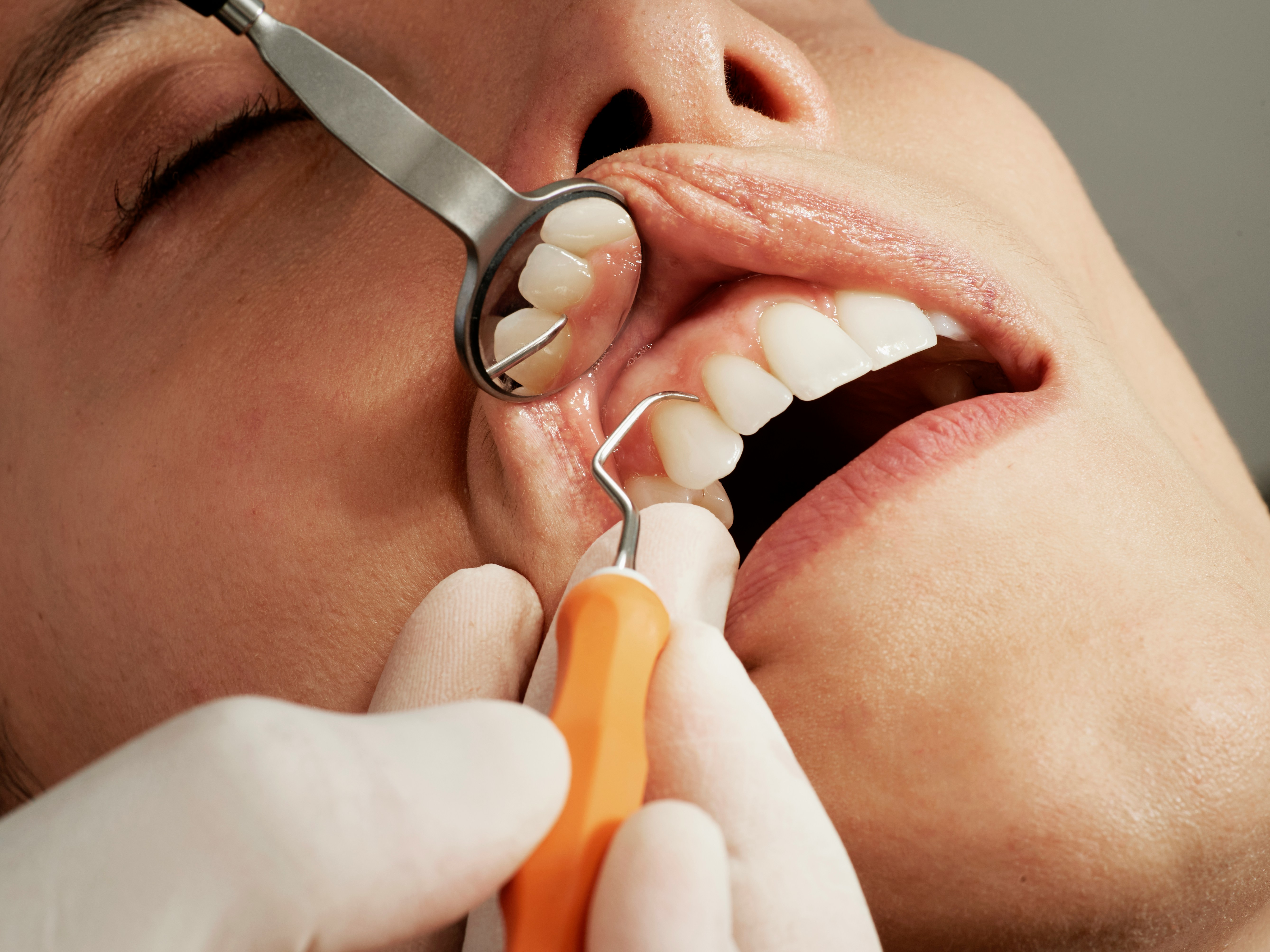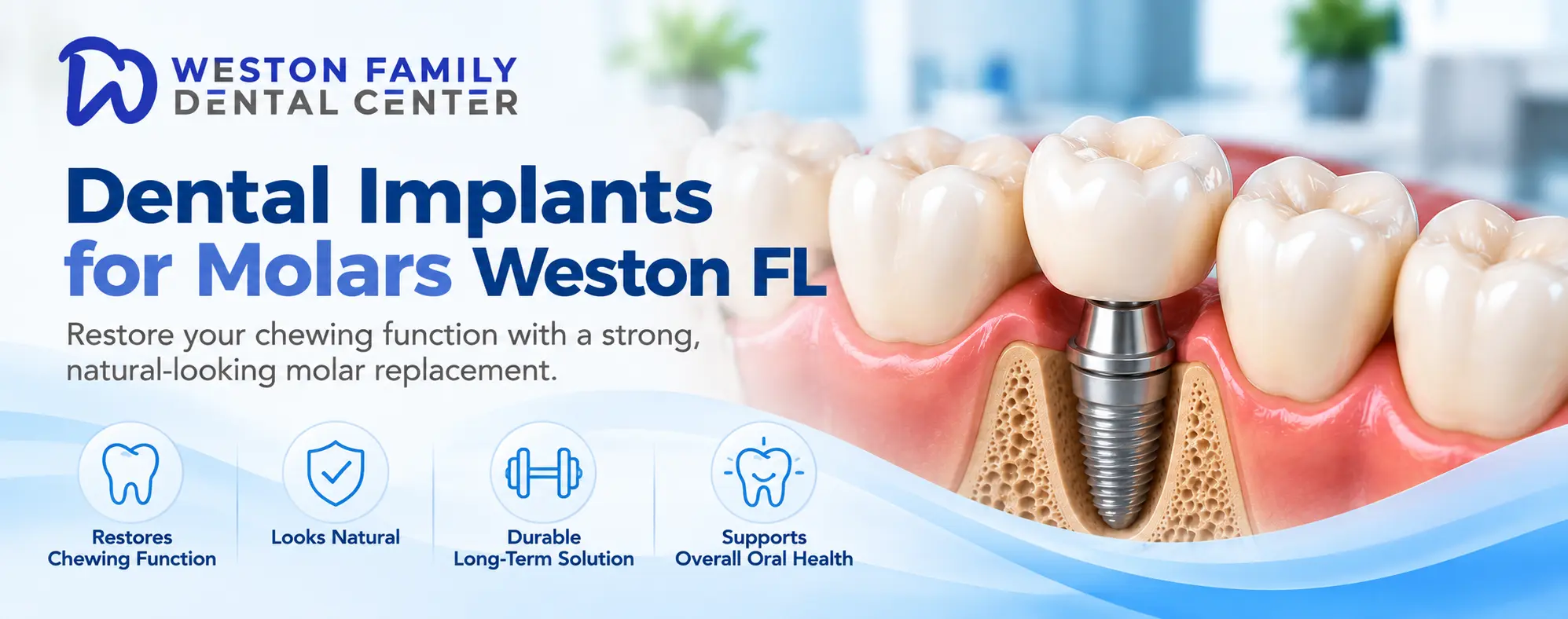
Losing a back tooth can feel less urgent than losing a front tooth. After all, a missing molar is usually hidden when you smile.
But there is another side to the story: molars do a lot of the work involved in chewing and grinding food. When one is missing, you may notice that you naturally chew on the opposite side or avoid certain foods.
For patients considering dental implants for molars Weston FL, the decision is not simply about filling an empty space. A dentist needs to look at the location of the missing tooth, available jawbone, bite, neighboring teeth, gum health, and the type of restoration that will be placed over the implant.
Here are seven important facts to understand before deciding how to replace a missing molar.
Why Molars Are Important Even Though They Are in the Back
Molars are posterior teeth, meaning they are located toward the back of the mouth. Their broad surfaces are designed to handle substantial chewing and grinding forces.
A missing molar does not automatically mean you will develop serious dental problems. However, the gap can affect how you distribute chewing forces and how the surrounding teeth function.
For example, someone who loses a lower molar may gradually rely more heavily on the teeth on the other side of the mouth. The experience is different for everyone, but changes in chewing habits are one reason dentists consider function when planning tooth replacement.
The condition of the neighboring teeth also matters. A dental examination can determine whether the teeth around the missing tooth are healthy enough to support normal bite alignment and whether replacing the missing tooth is appropriate.
7 Key Facts About Dental Implants for Molars
1. Molars Handle Significant Chewing Forces
One of the biggest differences between replacing a front tooth and replacing a molar is function.
Front teeth are primarily involved in biting and cutting food. Molars have larger surfaces designed for grinding, which means the restoration must be planned with chewing forces and bite pressure in mind.
This is one reason a dental implant for molar tooth replacement involves more than simply placing an implant in the empty space.
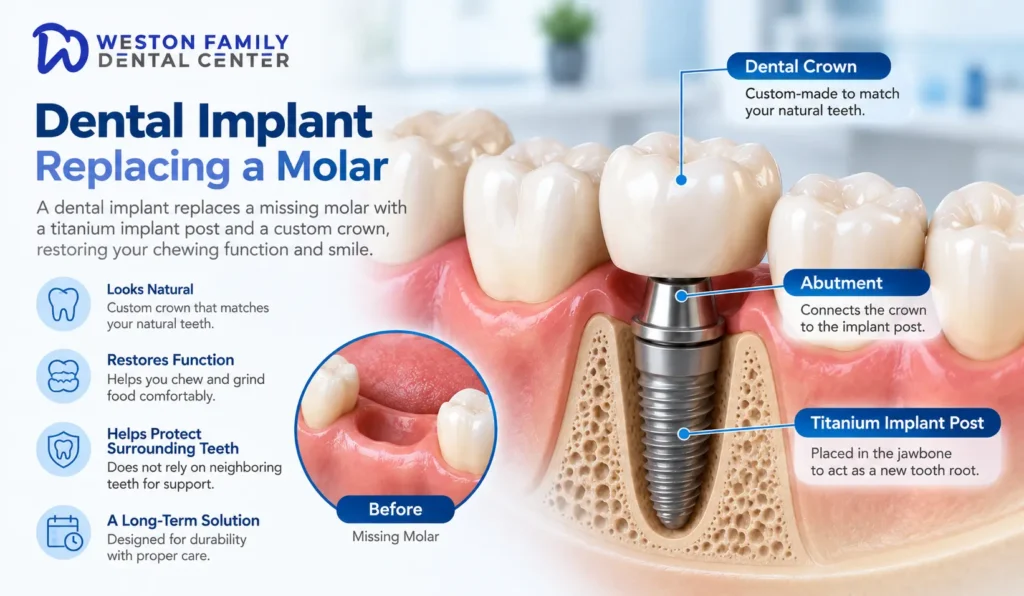
The implant post is positioned within the jawbone, and the final dental crown must be designed to work with the patient’s existing bite. The dentist also considers the relationship between the new restoration and the neighboring teeth.
Good treatment planning is therefore important. The goal is not simply to replace what is missing visually, but to create a restoration that fits the patient’s overall bite and chewing function.
2. Bone Condition Matters
A dental implant needs a suitable supporting bone.
After a tooth is lost, the surrounding jawbone can change over time. The amount and shape of available bone can therefore become an important part of implant treatment planning.
Before recommending an implant, a dentist may use dental imaging to evaluate the area and determine whether there is enough bone volume for implant placement.
In some situations, additional bone support may be considered. This is where a bone graft before dental implants may become part of the treatment plan.
That does not mean every patient with a missing molar needs grafting. The need depends on the individual anatomy and the amount of supporting bone available.
If you are interested in the subject, our related guide on “Do You Need a Bone Graft Before Dental Implants?” can provide more background without repeating the clinical evaluation that must happen in the dental office.
3. Upper and Lower Molars Can Present Different Planning Considerations
The location of a missing molar matters.
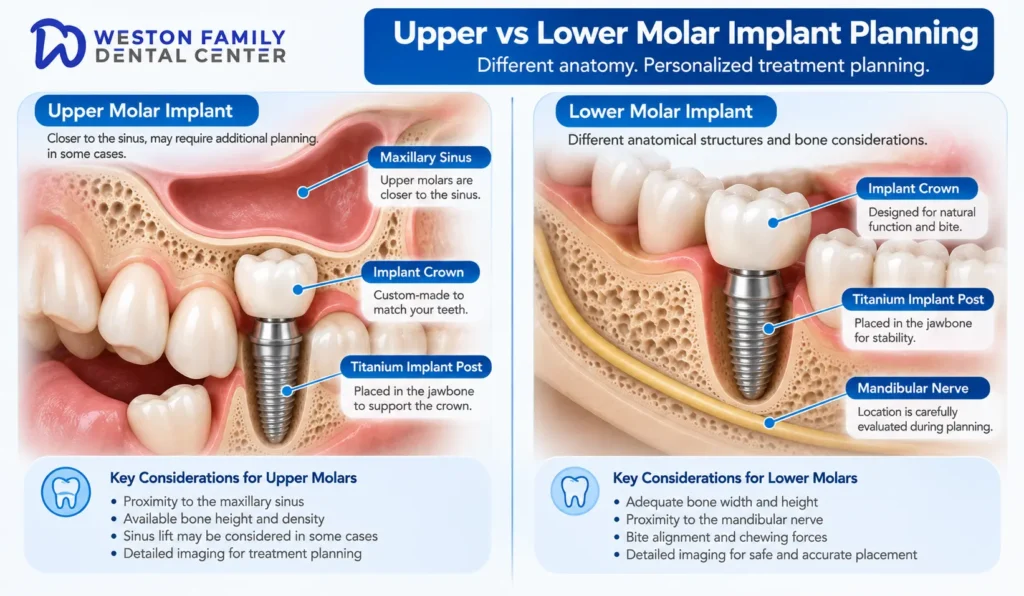
Upper molars are located relatively close to the maxillary sinus. In some patients, the available bone between the tooth site and sinus may be limited. Dental imaging helps the dentist understand the anatomy before treatment is planned.
Lower molars have a different anatomical environment. The dentist must evaluate the available bone and the position of nearby structures when considering implant placement.
This is why there is no universal treatment plan for molar dental implants Weston FL patients can simply follow.
Two people can both have a missing molar but require completely different treatment plans because their bone volume, tooth position, gum health, and bite are different.
A sinus-related procedure may be appropriate in certain upper-jaw cases, but it is not automatically required for every upper molar implant.
4. One Missing Molar Does Not Always Mean One Implant Is the Only Consideration
A single missing tooth may often be evaluated for a single implant and crown, but the dentist still needs to look at the bigger picture.
Important factors include:
- How many teeth are missing
- The condition of neighboring teeth
- Available jawbone
- Gum health
- Bite alignment
- Overall oral health
- The location of the missing tooth
For a single missing molar, a single tooth dental implant Weston patients are considering may be one possible option.
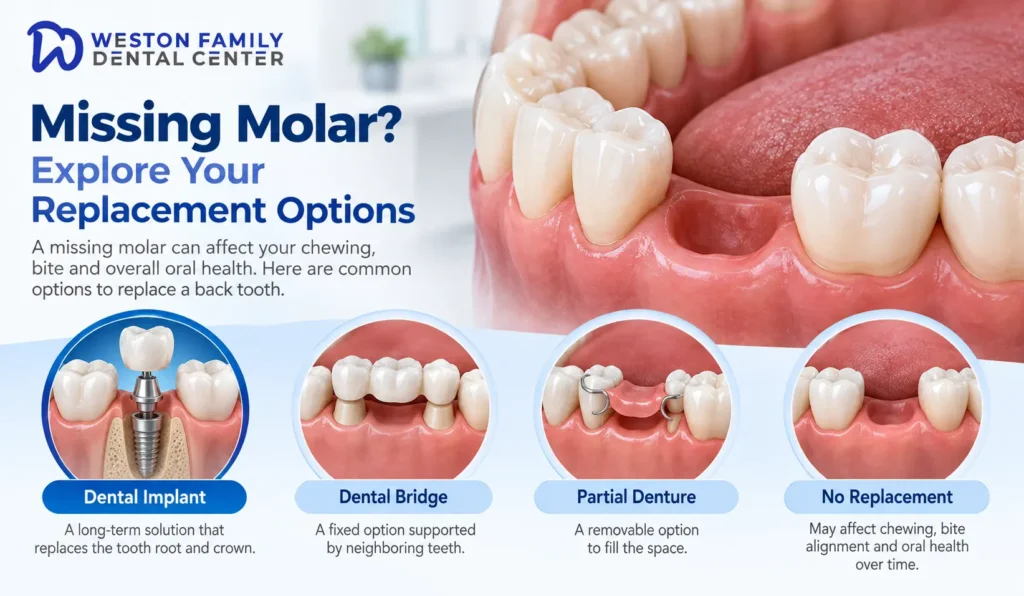
For multiple missing teeth, the treatment plan can be different. Depending on the situation, options may include multiple implants, implant-supported restorations, or a dental bridge.
If you are comparing options, our guide on dental implants vs bridges can help explain the basic differences. The important point is that neither option is automatically appropriate for every patient.
5. The Crown Is an Important Part of the Result
The implant is only one part of the finished restoration.
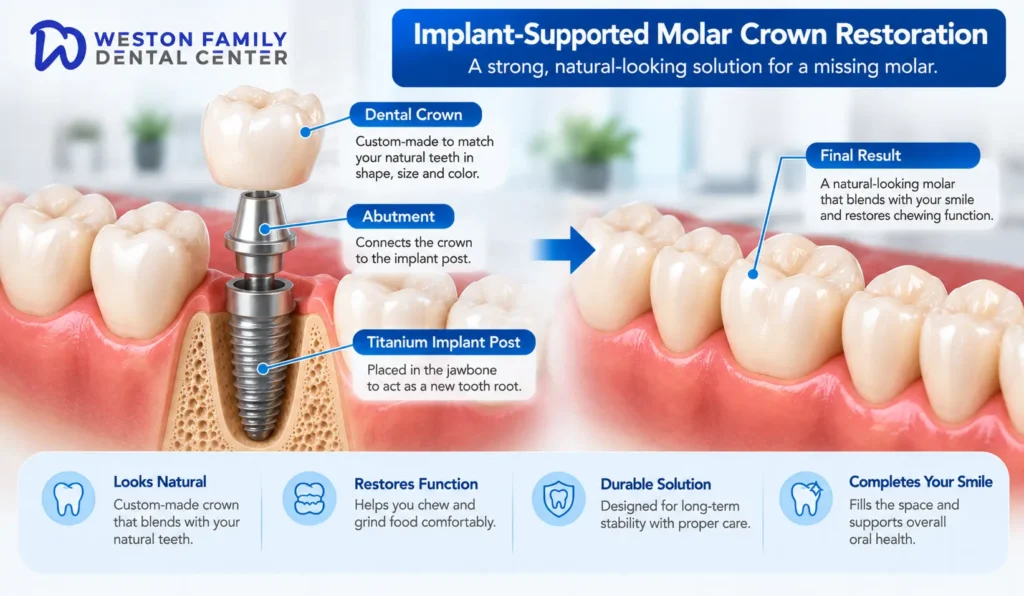
After the implant has been placed and the area has healed appropriately, the final restoration may include an implant-supported crown designed to replace the visible portion of the missing tooth.
For a molar, the crown needs to fit into the patient’s existing bite and work alongside the neighboring teeth.
The dentist may consider:
- Crown size
- Shape and position
- Bite relationship
- Chewing function
- Contact with neighboring teeth
- The overall dental restoration plan
This distinction is worth understanding because patients sometimes use the words “implant” and “replacement tooth” interchangeably. Technically, the implant post and the crown serve different roles.
The implant provides support within the jaw, while the crown replaces the visible tooth structure.
6. Cleaning a Molar Implant Still Matters
A molar implant may be out of sight, but it still needs regular care.
Because it is positioned toward the back of the mouth, some people may find the area more difficult to access when brushing or cleaning between teeth.
Good oral hygiene remains an important part of maintaining the surrounding teeth and tissues.
Your routine may include:
- Brushing consistently
- Cleaning between teeth
- Following your dentist’s recommendations
- Keeping regular dental examinations
- Reporting unusual changes or discomfort to your dental team
An implant should not be treated as a reason to stop paying attention to the rest of your mouth.
The neighboring teeth, gums, and surrounding tissues remain important to your overall oral health.
Our existing article “How Long Do Full-Arch Dental Implants Last?” discusses implant longevity in a full-arch context. A molar implant is a different situation, so its maintenance should be considered as part of an individual treatment plan rather than applying full-arch information directly to a single tooth.
7. The Right Treatment Depends on Your Individual Anatomy
There is no single answer for every missing molar.
Before recommending dental implants for molars Weston FL patients may be considering, a dentist can evaluate several factors together rather than looking at the missing tooth in isolation.
These may include:
- Bone volume and bone density
- Gum health
- Neighboring teeth
- Bite alignment
- Dental imaging
- Overall oral health
- Number of missing teeth
- Exact location of the tooth
This evaluation helps determine whether an implant is appropriate and whether additional treatment should be considered.
Weston Family Dental Center offers dental implant and restorative services, including single-tooth dental implants and implant restorations, along with digital diagnostic technology used for treatment planning.
Can a Molar Be Replaced With a Dental Implant Years After It Was Lost?
Sometimes, yes. The number of years since tooth loss does not by itself determine whether an implant can be placed.
What matters is the condition of the area today.
Changes in the jawbone can occur after tooth loss, and the amount of available bone may influence implant planning. Previous dental treatment, gum health, neighboring teeth, and other anatomical factors can also matter.
That is why someone who lost a molar several years ago should not assume that the opportunity for implant treatment has automatically passed.
Dental imaging and a clinical examination can provide a much clearer picture of the available options.
If bone volume is limited, additional treatment may sometimes be considered. AAOMS materials note that insufficient bone can occur for several reasons, including changes following tooth loss and sinus-related anatomy, and that bone augmentation may be considered when adequate support is needed for implant placement.
Dental Implant vs Bridge for a Missing Molar
Both implants and bridges can be used as tooth-replacement options in appropriate situations, but they work differently.
| Consideration | Dental Implant | Dental Bridge |
| Tooth replacement | Uses an implant-supported restoration | Uses neighboring teeth to support the replacement |
| Adjacent teeth | The implant itself supports the replacement | Neighboring teeth are involved in supporting the bridge |
| Bone involvement | Requires suitable bone for implant placement | Does not place an implant into the jawbone |
| Treatment planning | Includes implant placement and a healing period | Focuses on the bridge and supporting teeth |
The right choice depends on factors such as your oral health, anatomy, neighboring teeth, preferences, and overall treatment plan.
Rather than choosing between a bridge and an implant based on a single factor, discuss both options with your dentist.
What to Ask Your Dentist About a Molar Implant
If you are considering tooth replacement, taking a few questions to your consultation can make the conversation much easier.
Ask:
- Is a dental implant appropriate for my missing molar?
- Do I have enough bone for implant placement?
- Will I need a bone graft?
- Is my gum health suitable for treatment?
- What type of crown or restoration would be used?
- How does my bite affect the treatment plan?
- What alternatives should I consider?
- What should I expect during the healing period?
You can also ask how long the overall treatment process may take and whether your existing dental work could affect the plan.
Our guide on dental implant consultation can be useful before your appointment because it explains what patients may want to discuss with their dental team.
Replacing a Molar Starts With Understanding the Bigger Picture
A missing molar may not be visible when you smile, but it still has a role in everyday chewing and bite function.
That is why replacing a back tooth is not simply a matter of filling a gap. The dentist needs to consider the supporting jawbone, neighboring teeth, bite, location of the tooth, restoration design, and your overall oral health.
For someone considering dental implants for molars Weston FL, the most useful next step is an individual evaluation rather than trying to determine suitability from a checklist online.
Weston Family Dental Center provides family, restorative, and implant dentistry in Weston, Florida, including single-tooth dental implants and implant restorations.
Book a consultation or call us that can help you understand whether an implant, bridge, or another tooth-replacement option makes sense for your particular situation.
FAQs:7 Facts About Dental Implants for Molars Weston FL
Can you get a dental implant for a molar?
A molar can sometimes be replaced with a dental implant. Whether it is appropriate depends on factors such as bone availability, gum health, the condition of nearby teeth, bite, and overall oral health. A clinical examination and appropriate imaging are needed to determine suitability.
Are molar implants different from implants for front teeth?
The basic implant concept is similar, but treatment planning can differ. Molars are posterior teeth that handle substantial chewing forces, so bite pressure, available bone, restoration design, and access for cleaning can be especially important.
Can a molar implant be placed after years of tooth loss?
It may be possible. The time since tooth loss is only one consideration. Changes in the jawbone and surrounding anatomy may affect treatment planning, so imaging and an examination are important.
Do upper molars always need a sinus lift?
No. A sinus lift is not automatically required for every upper molar implant. The need depends on the anatomy of the individual treatment site and the amount of bone available.
Do you need a bone graft for a molar implant?
Not necessarily. Some patients have adequate bone for implant placement without grafting. Others may need additional bone support depending on the condition and dimensions of the implant site.
How long does a molar dental implant last?
There is no single lifespan that applies to every implant. Longevity can be influenced by oral hygiene, gum health, bite forces, the condition of surrounding tissues, restoration care, and regular professional monitoring.
Is a dental implant better than a bridge for a missing molar?
Neither option is universally better for every patient. Implants and bridges involve different treatment approaches, and the appropriate choice depends on anatomy, oral health, neighboring teeth, preferences, and the dentist’s treatment plan.