Losing a single tooth—whether from an unexpected injury, deep decay, or a failed root canal—often triggers an immediate desire to find a solution. Many patients in South Florida initially assume that replacing one missing tooth is a simple, standard procedure. However, when evaluating modern single tooth replacement options, two distinct treatment paths stand out: dental implants and traditional dental bridges. Understanding the clear trade-offs between dental implants vs bridges Weston patients encounter during their clinical evaluations is essential for making an informed decision that protects your long-term oral health.
Choosing between a single tooth implant Weston practice offers and a tooth-supported bridge involves looking beyond the immediate visual result. Each approach interacts differently with your neighboring teeth, jawbone, daily oral hygiene routine, and future restorative needs. By evaluating how these two proven solutions function over time, Weston residents can choose a tooth replacement pathway that best aligns with their health goals, budget, and lifestyle.
Why Replacing a Single Missing Tooth Matters
When a single tooth is lost, it is easy to view the gap as merely a minor cosmetic concern or chewing nuisance. However, even one missing tooth sets off physical changes within the mouth. Surrounding adjacent teeth naturally begin to drift into the open space, altering your alignment and creating uncomfortable bite imbalances. Furthermore, the opposing tooth in the opposite arch can super-erupt into the gap because it no longer has a contact partner during chewing function.
Leaving a space unaddressed also creates hard-to-reach traps where plaque accumulates, increasing the risk of localized gum disease and decay on neighboring teeth. While it is helpful to understand what can happen when a missing tooth is left untreated, addressing a missing tooth replacement promptly helps preserve natural tooth alignment, stabilizes your bite mechanics, and protects your smile aesthetics.
Dental Implants vs Bridges Weston: What’s the Basic Difference?
To understand which missing tooth replacement option fits your needs, it helps to examine how each restoration is constructed and supported within the mouth.
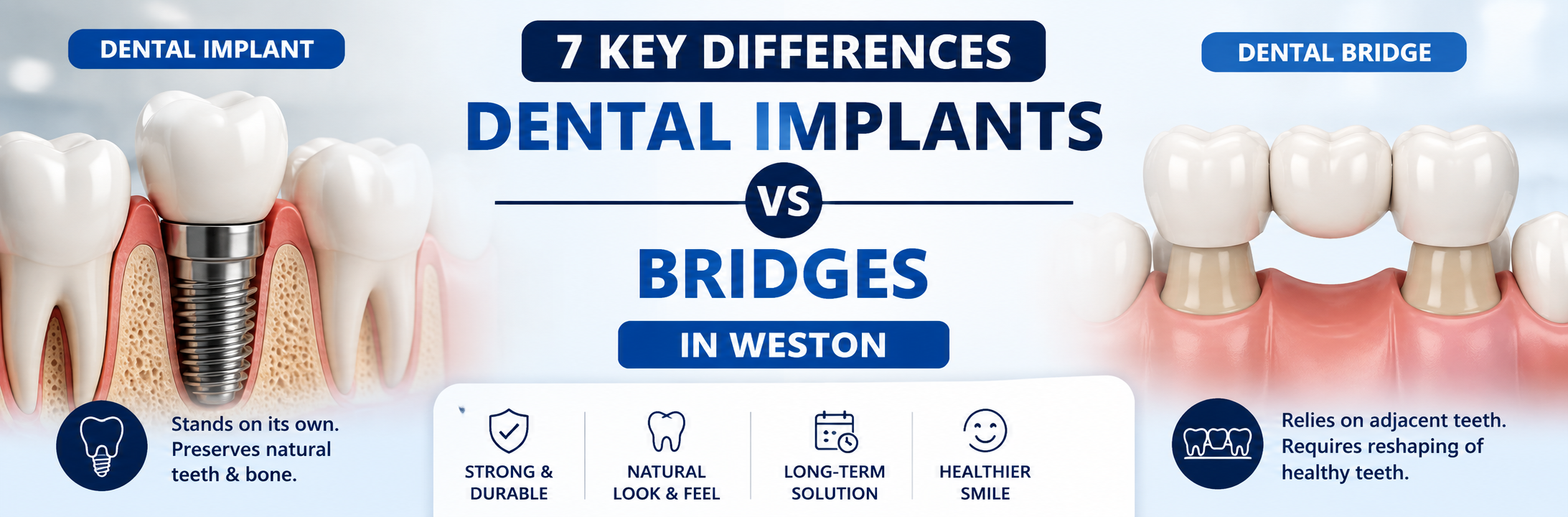
A single dental implant is a standalone structure designed to replicate the complete anatomy of a natural tooth. It consists of a biocompatible titanium implant post that serves as an artificial root, an abutment connector, and a custom dental crown that sits above the gumline. Because the implant post fuses directly with the jawbone through osseointegration, the restoration stands entirely on its own without requiring support from neighboring teeth.
Conversely, a traditional dental bridge is a tooth-supported bridge that relies on the strength of adjacent teeth flanking the gap. To place a standard three-unit bridge, the dentist must reshape and reduce the enamel on the two healthy neighboring teeth (abutment teeth) so they can anchor custom crowns. These crowns support a central artificial tooth (pontic) that spans the space. The resulting restoration is fixed in place, but its stability depends entirely on the health of those adjacent natural teeth.
7 Key Differences Between Dental Implants and Bridges
When comparing a dental implant vs bridge, reviewing specific functional and structural categories clarifies how each treatment performs over time.
1. How Each Option Is Supported
The primary distinction between these two tooth replacement options Weston dentists provide lies in their support structure:
- Dental Implant: Anchored directly into the jawbone. The biocompatible post acts as an artificial root, bearing bite forces independently without placing stress on nearby teeth.
- Dental Bridge: Anchored to adjacent teeth. The restoration relies entirely on neighboring natural teeth for physical stability, distributing chewing forces onto those supporting anchor teeth.
2. What Happens to the Neighboring Teeth
Preserving natural tooth structure is a major principle of modern dentistry, and this is where the two treatments diverge significantly:
- Dental Implant: Leaves neighboring teeth untouched. There is no need to shave down adjacent enamel or place crowns on surrounding teeth. The adjacent teeth retain their full natural structure.
- Dental Bridge: Requires permanent alteration of adjacent teeth. Healthy enamel must be trimmed down on both sides of the gap to hold the bridge crowns. However, if those adjacent teeth already have large fillings or extensive decay, capping them with a bridge can provide a dual benefit by restoring them simultaneously.
3. Cleaning and Daily Oral Hygiene
Maintaining proper oral hygiene around your restoration is vital for preventing gum disease or recurrent decay:
- Dental Implant: Cleans just like a natural tooth. You can brush and floss normally between the implant crown and neighboring teeth using standard dental floss.
- Dental Bridge: Requires specialized cleaning tools. Because the artificial tooth is joined to supporting crowns, standard floss cannot pass between the teeth. Patients must use floss threaders or interdental brushes to sweep beneath the bridge pontic daily to remove plaque.
4. Jawbone Considerations
When a tooth root is lost, the section of jawbone that held that root no longer receives chewing stimulation, leading to gradual bone loss over time:
- Dental Implant: Preserves jawbone density. By placing an artificial root in the bone, chewing forces continue to stimulate bone tissue. For patients with localized bone loss, learning about bone grafting before dental implants can clarify how bone volume can be restored to support an implant safely.
- Dental Bridge: Does not prevent jawbone loss. Because a bridge rests above the gumline without a root in the bone, the jawbone beneath the missing tooth area will naturally shrink over time, though this generally does not prevent the bridge from functioning.
5. Treatment Timeline
The time required to complete treatment varies based on the biological processes involved:
- Dental Bridge: Offers a rapid turnaround time. A traditional bridge is typically completed in two to three weeks over two clinical visits.
- Single Dental Implant: Requires a multi-stage process. After surgical placement of the post, a healing period of three to six months is usually necessary for bone integration before placing the final crown. Understanding how dental implant treatment works helps set realistic expectations, though single-tooth treatment is simpler than full-arch care.
6. Appearance and Natural-Looking Results
Achieving realistic smile aesthetics is a top priority for patients receiving dental implants Weston FL services:
- Dental Implant: Emerges naturally from the gumline. Because the crown rises out of the soft tissue like a natural tooth, single implants offer exceptional aesthetic integration, especially in high-visibility areas.
- Dental Bridge: Restores visual completeness effectively. Modern ceramic and porcelain bridges match natural enamel shade and translucency very well, though significant bone loss beneath the pontic can sometimes require careful prosthetic shading.
7. Long-Term Considerations
Evaluating maintenance requirements and potential replacement cycles highlights long-term value:
- Dental Implant: Built for exceptional long-term durability. An implant post can last a lifetime with proper care, while the custom dental crown on top may require replacement after 15 to 20 years due to standard wear. Exploring facts about how long dental implants can last shows why implants are considered a long-lasting tooth replacement.
- Dental Bridge: Has a finite lifespan. On average, a dental bridge lasts 10 to 15 years before replacement may be needed due to cement wear or decay along anchor tooth margins. If an anchor tooth fails, the entire bridge must be replaced.
Which Option Is Right for You?
Neither treatment option is universally superior for every patient; the ideal choice depends on your unique clinical needs, oral health, and personal goals. When evaluating dental bridge Weston FL options against single-tooth implants, our team considers several factors:
- Condition of Adjacent Teeth: If neighboring teeth are completely healthy, an implant avoids altering intact enamel. If adjacent teeth require crowns or have large fillings, a bridge can restore the missing space while reinforcing those neighboring teeth.
- Jawbone Structure: Implants require adequate bone volume. If bone loss is significant and you prefer to avoid bone grafting, a traditional bridge offers a straightforward non-surgical alternative.
- Medical and Healing Factors: Conditions affecting bone healing or immune response (like uncontrolled diabetes) can influence predictability, making a comprehensive evaluation essential.
- Timeline and Budget: Patients needing rapid restoration for an upcoming event may prefer the quick timeline of a bridge. Additionally, while bridges may have lower initial costs, implants often offer higher long-term value by avoiding repeat replacement cycles.
While this article focuses on replacing a single missing tooth, patients facing more extensive tooth loss can also explore full-mouth dental implant options to restore full dental function.
Questions to Ask Before Choosing a Tooth Replacement
Preparing for your evaluation helps ensure a confident decision. Consider asking these practical questions during your dental implant consultation:
- Is an implant or bridge better suited for the specific location of my missing tooth?
- What is the health status of the teeth next to my missing tooth gap?
- Do I have enough jawbone density to support an implant, or is bone grafting recommended?
- What is the expected total treatment timeline for each option?
- What daily cleaning routine will be required to maintain my restoration?
- How do long-term costs compare over a 15 to 20-year period?
- Are there any health considerations in my medical history that favor one option over the other?
Reviewing these questions clarifies common dental implant myths and facts so you can weigh your options objectively.
Choosing the Best Tooth Replacement Path in Weston, FL
Both single-tooth dental implants and traditional dental bridges are proven, effective solutions for replacing a missing tooth and restoring your smile. While a bridge provides a rapid, non-surgical restoration supported by neighboring teeth, a dental implant offers an independent, bone-preserving solution that leaves adjacent enamel untouched. Understanding these core differences allows you to approach your tooth replacement decision with confidence.
At Weston Family Dental Center, we prioritize personalized dental care tailored to your unique health needs and goals. If you are missing a single tooth and want to explore whether a dental implant or bridge is right for you, we invite you to schedule a dental consultation with our experienced team today.
FAQs: 7 Key Differences: Dental Implants vs Bridges in Weston
Is a dental implant better than a bridge?
Neither option is universally better. The best choice depends on your oral health, jawbone structure, and goals. Dental implants preserve neighboring teeth and stimulate jawbone tissue, while bridges offer a non-surgical solution with a faster turnaround time.
Can a bridge replace just one missing tooth?
Yes. A single missing tooth is commonly replaced with a standard three-unit bridge, which consists of two crowns attached to adjacent teeth with an artificial tooth (pontic) in between.
Does a single dental implant look and feel natural?
Yes. A single dental implant emerges directly from the gumline and is topped with a custom porcelain crown, functioning and appearing virtually identical to a natural tooth.
How long does a dental bridge last compared to an implant?
A dental bridge typically lasts 10 to 15 years before requiring maintenance or replacement. An implant post can last a lifetime, though the custom crown on top may need replacement after 15 to 20 years.
Can I get a dental implant immediately after losing a tooth in Weston, FL?
In many cases, an immediate dental implant can be placed into the extraction socket on the same day a tooth is removed, provided there is sufficient healthy bone and no active infection.